Six Mistakes Founder-Led Service Firms Make When Installing AI (And How the 3-6-9 System Prevents Them)
Most founder-led service firms who installed AI tools in the last 18 months would be hard-pressed to name three measurable improvements. They didn't fail at AI. They failed at sequence. Six mistakes show up consistently across the firms 369 has reviewed, and each one is preventable.
What are the most common AI installation mistakes for founder-led B2B service firms?
The six below, in order of frequency. Each one maps to a missing layer that the 3-6-9 Growth System™ installs in sequence.
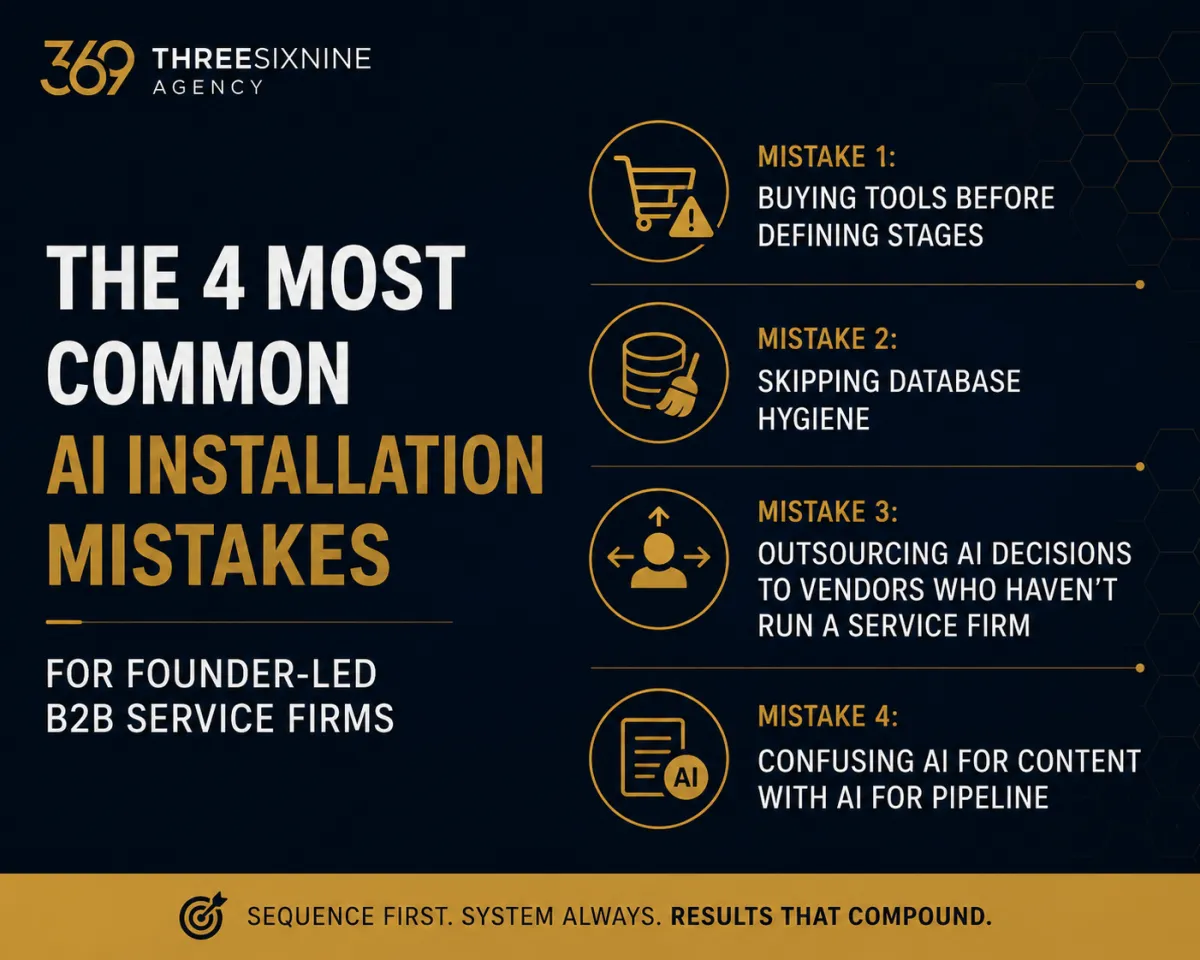
Mistake 1: Buying tools before defining stages
The most common failure. A founder reads about an AI scoring tool, buys it, plugs it in, and waits for conversion to improve. The tool ranks leads correctly. The team has no defined response for what to do with the rankings. The pipeline doesn't change.
How the 3-6-9 system prevents it: AlignCore™ (Phase 6) defines stages with yes-or-no criteria before any AI layer goes on top. The tool now has something coherent to operate against.
Mistake 2: Skipping database hygiene
Firms install AI on top of a CRM that hasn't had a tagging audit in years. The model trains on noise. The output is ranked noise. The founder concludes AI doesn't work for our firm.
How the 3-6-9 system prevents it: Reboot Engine™ (Phase 3) runs a tagging audit and archival pass before anything else goes on top. The data underneath the model is clean.
Mistake 3: Outsourcing AI decisions to vendors who haven't run a service firm
The vendor installs an enterprise-sales-motion AI workflow on a three-person service firm. The workflow assumes infrastructure the firm doesn't have. The team adopts nothing. The founder pays for tools that sit idle.
How the 3-6-9 system prevents it: The 369 install is operated by people who have built and sold founder-led service firms. The architecture compresses to actual service-firm scale, not enterprise-template scale.
Mistake 4: Confusing AI for content with AI for pipeline
Two different problems, two different solutions. Founders see AI for B2B content and assume one tool solves both. AI for content (the Voice Intelligence™ Service Line) maintains a founder's voice in market. AI for pipeline (the 3-6-9 Growth System™) runs the operating layer underneath sales. Both can compound, but they don't substitute for each other.
How the 3-6-9 system prevents it: The two service lines are explicit. Each one solves a different problem. Founders don't accidentally buy content automation expecting it to fix conversion.
Mistake 5: Installing without a weekly scorecard
The firm installs AI tooling and never installs the rhythm of reviewing what the tooling is doing. Six months in, the founder can't tell whether the install helped because nobody was tracking. The pattern repeats with the next tool.
How the 3-6-9 system prevents it: GrowthLoop™ (Phase 9) installs the weekly scorecard explicitly. Every install gets a measurable outcome the team and the founder review on a fixed rhythm.
Mistake 6: Treating AEO as a marketing project instead of a compliance project
The firm hires an SEO consultant to add some AI keywords to existing pages. The consultant produces generic AEO content. The firm's entity signal stays incoherent because the underlying structure ~ stages, services, offers ~ wasn't aligned first.
How the 3-6-9 system prevents it: AEO compliance is integrated into AlignCore™ (Phase 6). The firm's entity layer aligns with the same structure that aligns its pipeline. Schema markup, internal linking, and entity validation become consequences of having a clear operating system, not bolt-on tasks.
How does the 3-6-9 Growth System™ prevent each of these in sequence?
By installing in phases that absorb each layer before the next one arrives. Reboot Engine™ fixes Mistakes 2 and 5 (clean data, scorecard rhythm). AlignCore™ fixes Mistakes 1 and 6 (stages defined, AEO compliance). The full sequence fixes Mistakes 3 and 4 (operated by people who've run service firms, distinct service lines for distinct problems).
The firms that avoid all six mistakes don't do so by being smarter. They do by sequencing the install instead of stacking the tools.
