Owned Data as Pipeline Predictability: How Expert Consultants and Fractional CMOs Turn First-Party Signal Into Revenue
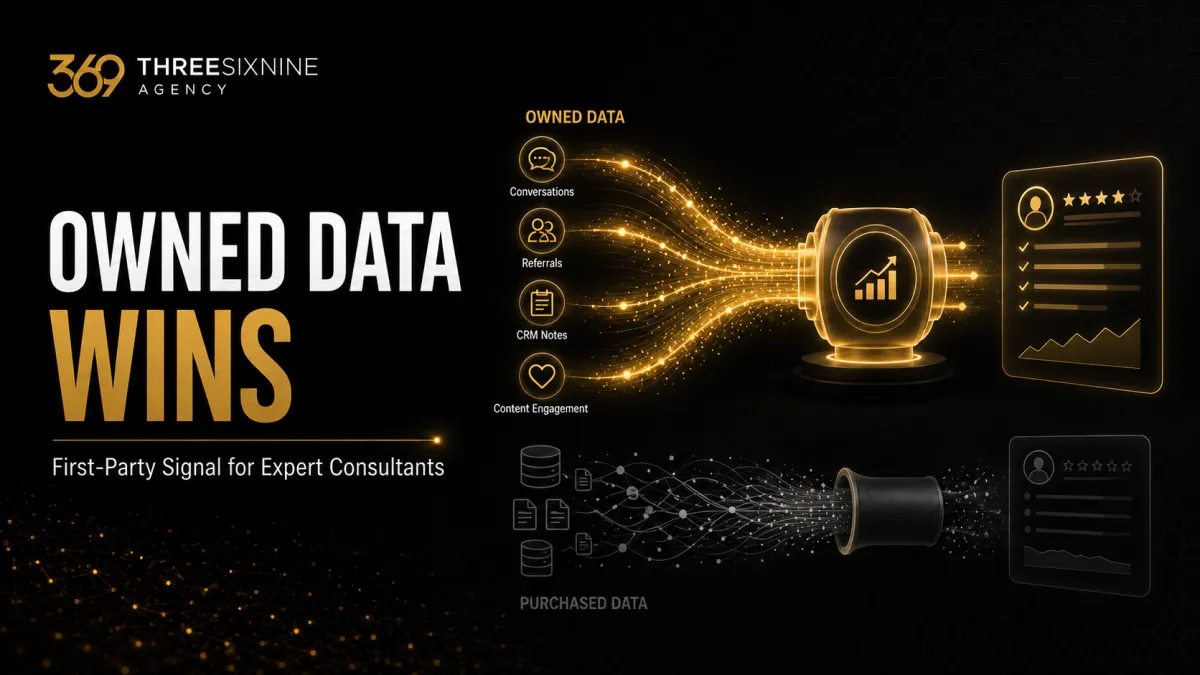
The expert consultant who's been working in their space for fifteen years sits on more first-party signal than any platform can sell them. Conversations. Referrals. Content engagement. Network depth. Most of that signal stays trapped in inboxes and CRM notes because there's no system to convert it into pipeline. The firms that build one stop competing on volume and start competing on intelligence.
This is the case for owned data over purchased data ~ specifically for fractional CMOs, expert consultants, and small expert-services firms whose value is judgment, not throughput.
What is first-party data (zero-party plus first-party) and why does it matter for expert consultants?
First-party data is the information the firm collects directly from buyers and prospects through its own channels. Form fills, conversation notes, email engagement, content signal, referral patterns.
Zero-party data is a subset of first-party ~ information the buyer deliberately provides, like preferences, situation context, and stated needs.
For expert consultants, this category of data matters more than for any other business type because the consultant's edge is judgment about specific situations. The richer the firm's first-party data, the better-calibrated the judgment, the higher the conversion rate, the higher the engagement quality.
Purchased data ~ third-party lead lists, prospect databases, intent platforms ~ delivers volume. Volume isn't the bottleneck for expert businesses. Judgment is. Owned data sharpens judgment. Purchased data dilutes it.
Why are fractional CMOs and consultants underleveraging their owned data?
Three reasons.
The first is tool fit. Most CRMs are built for volume sales operations. Expert consultants run boutique pipelines. The tools either don't capture the right signal or capture too much of the wrong signal.
The second is time. The consultant is the product. Every hour spent maintaining data systems is an hour not spent on delivery. Most expert firms never build the data layer because the consultant is the bottleneck on building it.
The third is awareness. Most expert consultants don't realize how much signal they already have. The CRM looks empty. The conversation history sits in email. The referral pattern lives in memory. Until someone runs the audit, the asset is invisible.
What's the difference between owned data and purchased data for an expert business?
Owned data tells the firm what its actual buyers actually do. Purchased data tells the firm what some superset of buyers might theoretically do.
For expert firms, the actual data is more valuable than the theoretical data by an order of magnitude. The expert is selling judgment on specific situations. Specific data sharpens that judgment. General data adds noise.
This is also where AEO matters disproportionately for expert firms. AI search engines rank firms on entity coherence and consistency. An expert firm with rich first-party signal and clear entity structure outranks a larger competitor with thin signal and generic content. The expert firm that builds its owned-data layer also builds its AEO authority in the same motion.
How do AlignCore™ and GrowthLoop™ convert first-party signal into a pipeline?
AlignCore™ (Phase 6) does the structural work. It defines what the firm captures, how the captures get tagged, and how the signal maps to the firm's offer. Without AlignCore™, the owned data sits scattered.
GrowthLoop™ (Phase 9) does the rhythm work. The weekly scorecard surfaces patterns in the owned data. The expert sees which engagement signals correlate to which closes. The pipeline becomes predictable because the firm is now reading its own signal rather than guessing.
The combination converts first-party signal from a passive asset into a working pipeline mechanism. Within 60 to 90 days, most expert firms can predict their next quarter's revenue from their owned-data signal with notable accuracy.
What does a working data system look like for a 1-3 person expert firm?
Smaller than most consultants assume. The system isn't an enterprise data warehouse. It's a clean CRM with disciplined tagging, a content engagement tracker, and a weekly scorecard.
Five components. Form intake that asks the right zero-party questions. Conversation logging that captures the signal without consuming hours. Content engagement signal that flows into the CRM. A tagging discipline that turns the data into something a non-data-person can read. A scorecard that publishes weekly.
Most expert firms can install this in 4 to 6 weeks. The bigger constraint is the consultant's time during install. Once installed, the system runs without ongoing maintenance.
How does AEO compliance amplify owned-data leverage?
AEO compliance and owned-data discipline are the same structural work in two different directions. Both require the firm to be coherent about what it does, who it serves, and how the data lives. A firm that does one almost always builds the other in the same motion.
For expert consultants, this means the owned-data system isn't only a pipeline tool. It's also the foundation for AEO authority ~ AI engines see a firm with clear entity structure, consistent signal, and verifiable depth, and they rank it accordingly.
The expert firm that installs AlignCore™ and GrowthLoop™ correctly also becomes the firm AI search engines surface when buyers ask who's the leading expert on X.
What's the entry point for fractional executives exploring this?
The 369 diagnostic, run against the firm's existing CRM, content footprint, and AEO entity profile. Two outcomes possible. The firm's owned-data layer is closer to ready than the consultant thinks, in which case AlignCore™ or GrowthLoop™ is the right starting point. Or there's a Reboot Engine™ install that needs to run first to clean up what's already there.
Most fractional executives discover they're sitting on more pipeline asset than they realized. The work is making the asset legible.
