Recovering Unconverted Discovery Calls: How Conversational AI Closes the Gap Most Founder-Led Firms Don't See
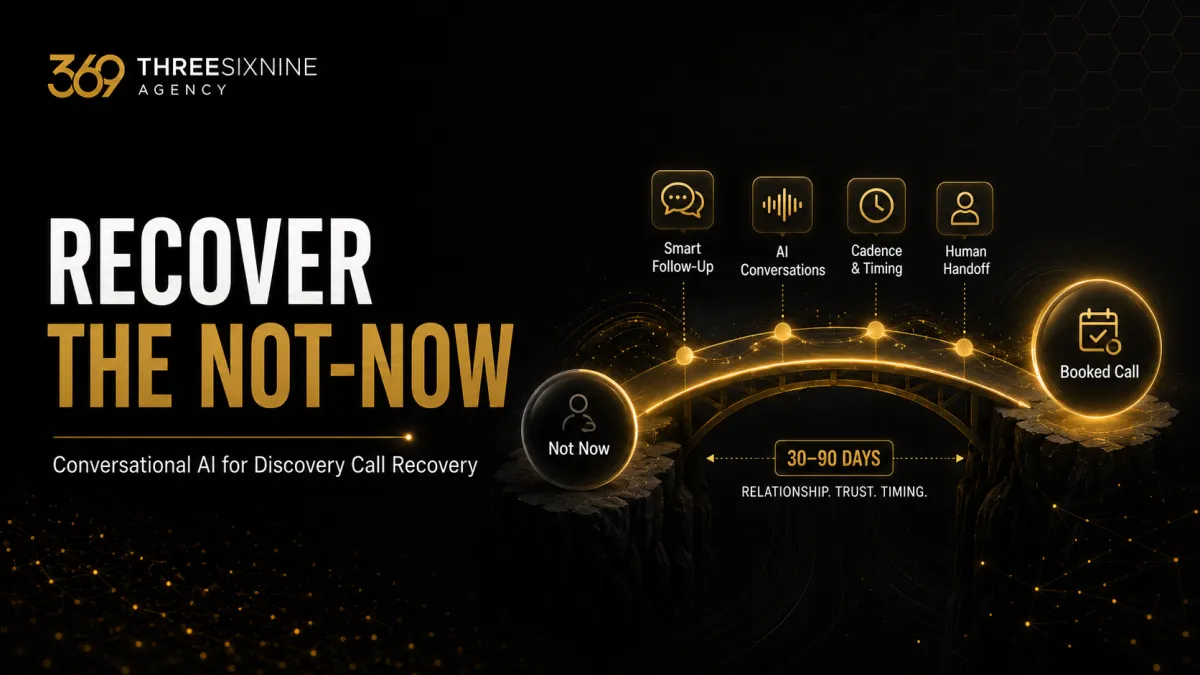
Every founder-led service firm has a folder, or worse, a memory, of discovery calls that didn't close. Most of those weren't no's. They were not-nows. The firms that turn not-nows into closed deals in the 30 to 90 day window have one thing in common ~ a follow-up rhythm that doesn't require the founder to remember anyone.
For fractional CMOs, expert consultants, and founder-led service firms, the discovery call recovery layer is often the single biggest piece of unrealized revenue. Conversational AI is the install that captures it.
What is the gap between not-now and no, and why do most firms lose money in it?
The gap is the 30 to 90 day window after a discovery call where the buyer isn't ready yet but hasn't said no. Most firms treat this window as a dead zone. They run a generic checking in email at day 30 and stop.
The buyer's situation usually shifts during this window. Internal priorities move. Budget cycles open. The problem the firm could solve becomes more painful. The firm that's in front of the buyer at the right moment in this window often closes deals that other firms have already given up on.
The reason most firms lose money here is structural, not strategic. The founder remembers the recent calls. The 30-day-old call is one of many. Without a system, the timing is random. With a system, the timing becomes the differentiator.
How does conversational AI bridge the gap?
By keeping the conversation alive at the cadence the buyer is most likely to engage with, in a tone that doesn't feel like sales follow-up. Three layers run concurrently.
Tracked engagement signals. The AI watches for signals the buyer is moving toward readiness ~ engagement with the firm's content, return visits to the website, response to a specific kind of message.
Cadence calibration. Touches are spaced based on the signal pattern, not a fixed sequence. Buyers who are early in the window get lighter touches. Buyers who show engagement get more substantive ones.
Human escalation. When a signal indicates the buyer is ready, the AI surfaces the conversation to the founder or the closer. The handoff happens at the right moment, not on a calendar reminder.
What does a recovered discovery call sequence look like?
Three to seven touches over 60 to 90 days, weighted toward value rather than ask. Useful content. Relevant signal. A specific reason to re-engage that ties to the buyer's actual situation, not the firm's calendar.
The sequence doesn't push. It maintains presence. When the buyer is ready, the firm is the one they remember.
What's the difference between conversational AI and a chatbot?
A chatbot answers questions on the website. Conversational AI manages a sustained, personalized exchange across multiple touches, channels, and timeframes.
The two get confused because both involve AI and language. The functions are different. A chatbot is a front-end interface. Conversational AI is a back-end relationship layer. Founder-led service firms usually need the second more than they need the first.
How does the AlignCore™ phase support discovery call recovery?
AlignCore™ defines what qualified means and what the firm's offer actually delivers. Without that clarity, recovered discovery calls run into the same friction that lost them in the first place ~ vague offer, unclear stages, no defined next step.
With AlignCore™ in place, the recovery sequence has something coherent to point the buyer back to. The conversation that resumes at day 60 picks up against a clear offer and a clear next step, not a re-explanation of what the firm does.
What do fractional CMOs and expert consultants do with this specifically?
Fractional executives sit on the highest-value lost-call portfolios in the market. Their discovery calls are with operators who genuinely needed help and weren't ready to engage when the conversation happened. The not-now window for these buyers is often 90 to 180 days, because executive hiring decisions move on internal cycles.
The fractional executive who installs conversational AI for discovery call recovery often doubles or triples their close rate from existing pipeline without adding any new top-of-funnel work. The leverage is unusually high because the call quality was already high.
What's the conversion lift to expect?
Specific numbers depend on the firm's discovery call volume and offer clarity. Pattern: firms with a clear offer and consistent discovery call quality typically recover 10 to 25 percent of previously-not-closed calls within the 90-day window once the sequence is installed. That range is what 369 has seen in service firm installs; individual firms vary.
How does this integrate with the rest of the 3-6-9 system?
Discovery call recovery sits inside AlignCore™ (Phase 6) and feeds GrowthLoop™ (Phase 9). The Reboot Engine™ (Phase 3) gets the firm's operating layer ready. AlignCore™ clarifies what's being recovered toward. GrowthLoop™ installs the rhythm. The whole sequence makes discovery call recovery a permanent capability rather than a one-time project.
