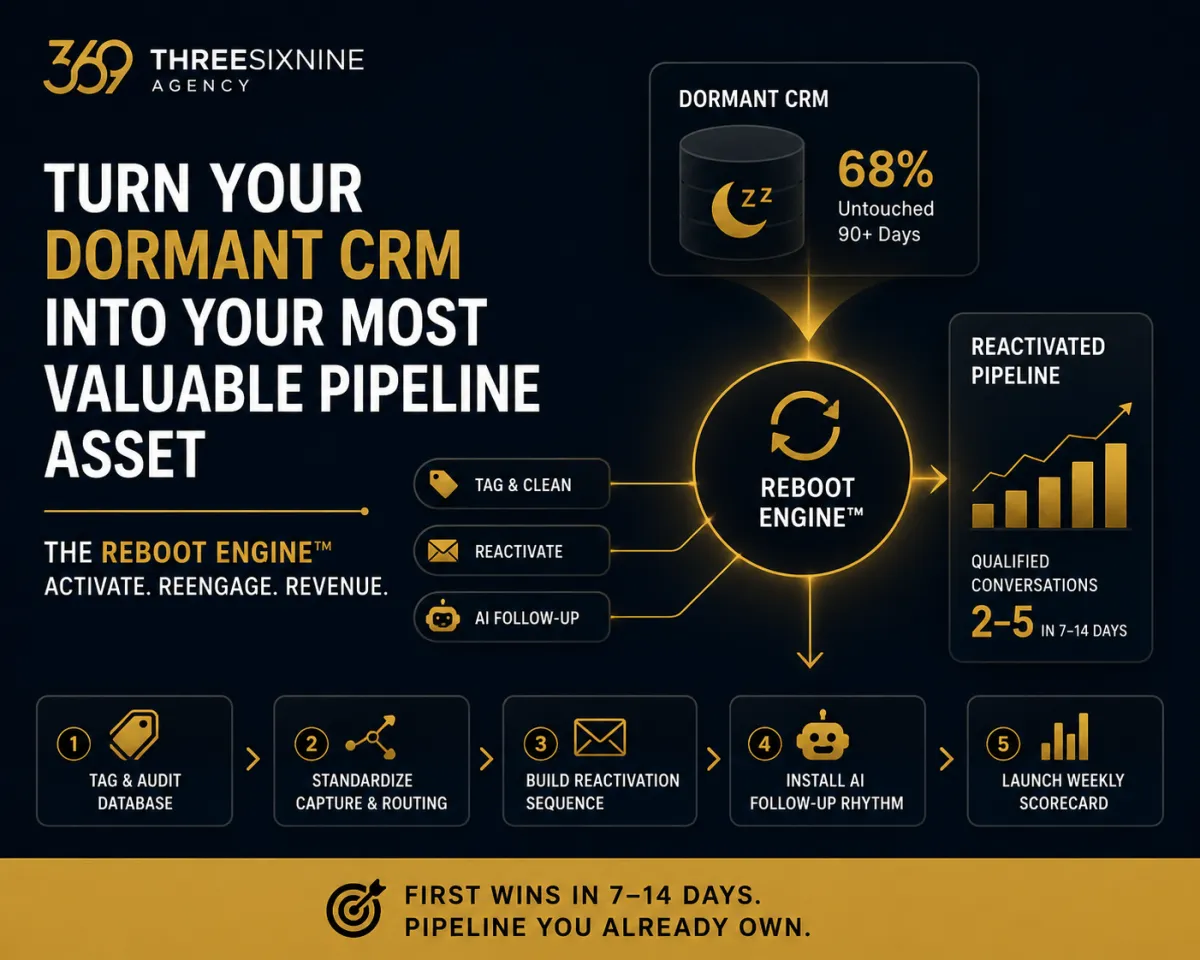
Reviving Dormant CRMs: The Reboot Engine™ for Founder-Led B2B Service Firms
The most valuable lead source for most founder-led service firms isn't on the next cold list. It's already in the CRM, sitting on a contact record that hasn't been touched in 90 or more days. The Reboot Engine™ exists to extract value from those records before any new lead generation begins.
For firms in the $500K to $5M ARR range, the dormant database often holds more potential revenue than the next 90 days of new pipeline work. The reason is structural ~ the contacts in there were once qualified enough to be entered. Most of them never got a real second touch. Many of them are now ready to talk for reasons that have nothing to do with the firm's marketing.
What is a dormant CRM and why is it the most overlooked pipeline asset?
A dormant CRM is a contact database where most records haven't been touched in 90 days or more. For founder-led service firms, this is almost always 60 to 80 percent of the database.
It's overlooked because the founder remembers entering those contacts manually, and the memory is we already worked these and they didn't close. That memory is usually wrong. What actually happened is that the contact entered the pipeline, got one or two touches, didn't close immediately, and quietly fell into the gap between no and not now. The firm logged the non-close as the answer and stopped following up.
The dormant database, worked correctly, is a near-pure source of qualified pipeline. The contacts are already in the firm's universe. They already showed enough interest to be entered. What's needed is the rhythm to surface the ones who are ready now.
What does the Reboot Engine™ actually do?
Five things, in sequence.
First, the database gets a real tagging pass. Every contact gets categorized by recency, source, and prior engagement signal. Contacts that should never have been entered get archived. Contacts that look reactivatable get tagged for sequencing.
Second, the capture and routing plumbing gets standardized. New inbound leads route through the same system as reactivation leads. The team operates one workflow, not three.
Third, the reactivation sequence gets built. Not a generic check-in email. A sequenced touch that surfaces the leads who are actually ready to talk now ~ usually a small percentage of the dormant database, and a disproportionately valuable one.
Fourth, the follow-up rhythm for both new and reactivated leads gets installed. AI handles the cadence. The team handles the conversations.
Fifth, a simple scorecard goes live. The founder sees leads in, qualified, closed, and leaked, on a weekly rhythm.
How long does a Reboot Engine™ install take?
7 to 14 days, end to end. The architecture is repeatable. The data is already there. The install isn't building anything new ~ it's organizing what the firm already has into a working operating layer.
First measurable wins typically land in the same 7 to 14 day window. The wins come from the dormant database, not from new lead generation, and they're usually the firm's first proof that the install was worth the spend.
What kinds of dormant contacts are worth reactivating?
Three types tend to convert at the highest rates.
The not-now, six to twelve months ago contacts. These are buyers who weren't ready when the firm first talked to them. Time has passed. Their situation has changed. The Reboot Engine™ surfaces them.
The ghosted after proposal contacts. These are buyers who got to a proposal stage and went quiet. Most firms write these off. Many of them simply got busy. Re-engagement at the right moment converts a meaningful percentage.
The introduction never followed up contacts. These are referrals or warm intros the founder made when the pipeline was hot and then dropped when the next deal landed. Reactivating these is often the highest-leverage move because the relationship layer is already established.
What does the AI layer do in the Reboot Engine™?
It handles the volume work. Cadence, timing, segmentation, light personalization based on prior engagement. The AI doesn't make the close. It surfaces the conversations the founder should be having and times the touches so the founder shows up when the contact is most likely to respond.
What does the human layer do in the Reboot Engine™?
It handles the close, the strategic decisions, and the quality control. The founder reviews the reactivation list before it runs. The team handles every conversation that converts to a live call. The AI surfaces; humans engage.
What results typically show up in 7 to 14 days?
Two to five reactivated qualified conversations from the dormant database, depending on the size and quality of what was sitting in the CRM. For most founder-led service firms, that's enough to cover the install cost in the first 30 days.
The bigger result is structural. The firm now has a working operating layer. The 3-6-9 sequence can proceed into Phase 6 (AlignCore™) on a clean foundation.
When is a Reboot Engine™ not the right starting point?
When the firm has fewer than 200 contacts in the CRM, the dormant database isn't large enough to justify the install ~ Phase 6 (AlignCore™) usually makes more sense as the entry point. When the firm's offer is unclear enough that even fresh leads aren't converting, AlignCore™ comes first; reactivation only works if the offer is something the firm can credibly deliver on.
The 369 diagnostic determines which phase is the right entry point.
