What AI Actually Changes for Founder-Led B2B Service Firms in 2026 (And What It Doesn't)
Half the AI promises landing in founder-led service firm inboxes in 2026 are real. The other half are the same recycled tactics with a new label. Telling them apart matters because the wrong bet costs more than money ~ it costs a year of the firm's growth.
For firms in the $500K to $5M ARR range, the AI question in 2026 isn't whether to adopt. The question is which layer of the firm AI is actually competent to install on. The honest answer doesn't match the marketing.
What does AI actually change for founder-led B2B service firms in 2026?
Three things, and they're more useful than the marketing suggests.
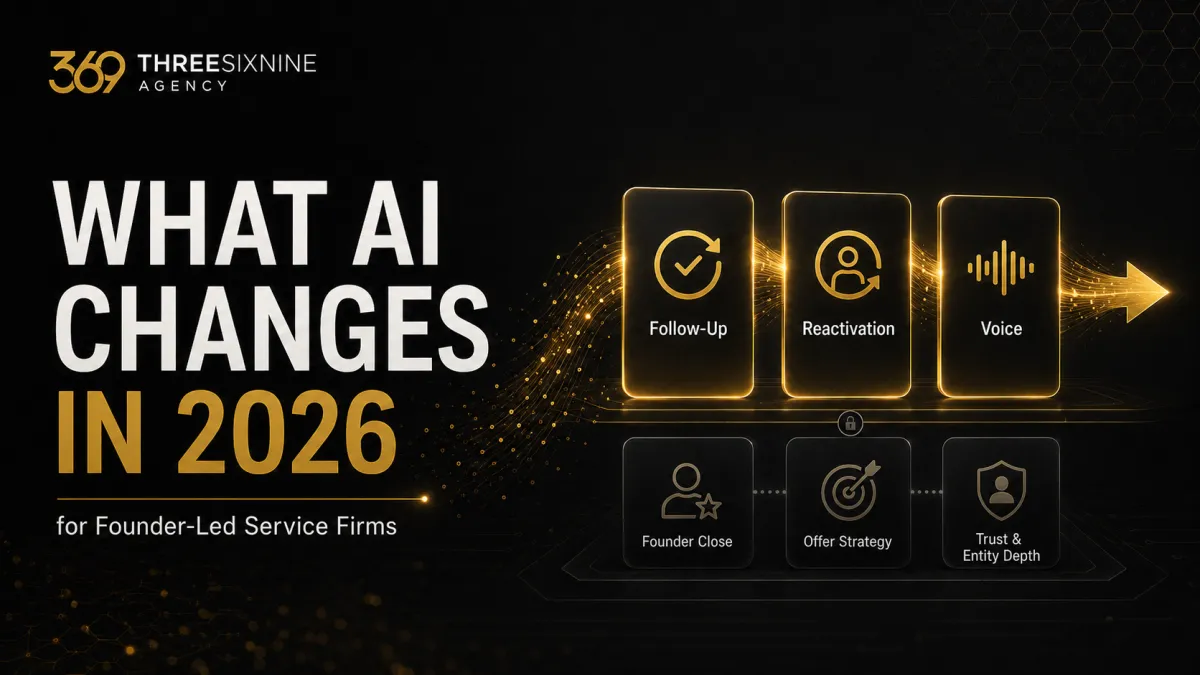
First, the work of follow-up rhythm. Founder-led service firms have always lost deals to inconsistent follow-up. AI handles that rhythm reliably ~ it doesn't forget, doesn't take Friday off, doesn't get distracted by a bigger deal. This single capability, applied to the existing CRM, often produces the highest-leverage gain a service firm sees from AI in 2026.
Second, the work of database reactivation. AI does this work at a volume and cadence no human team would sustain. For most firms, the dormant database holds more revenue than the next 90 days of new lead generation. AI makes mining that database economically viable for the first time.
Third, the work of voice consistency for the founder or principal. Service firms grow on the founder's voice in the market. AI can capture that voice and maintain it across LinkedIn, Substack, and long-form content without the founder spending hours per week writing. This is the Voice Intelligence™ layer of the 369 stack.
What doesn't AI change (despite the marketing)?
The closing capacity of the founder. AI doesn't close deals at the service-firm price point. It supports the close, accelerates qualification, and surfaces the right conversations. The founder still does the talking that turns a qualified lead into a signed contract.
The strategic decisions about what the firm actually sells. AI can phrase an offer well. It can't decide what the firm is or who it serves. Those are still founder decisions, and outsourcing them to an AI tool is how firms produce offers that read like a competitor's offer with the names changed.
The trust signal at the entity layer. AEO depends on the firm's actual depth and consistency, not on AI-generated content density. Volume of AI-generated articles without entity coherence damages the firm's authority signal rather than building it.
What's the difference between AI that fits a service firm and AI that fits an enterprise?
Service firms run on relationships. Enterprises run on workflows. Most AI tools are built for the workflow case ~ ten people, eight stages, hundreds of leads per week. Service firms have three people, two stages, a handful of high-value conversations per week.
AI that fits a service firm is AI that compresses to the actual scale. Follow-up automation for the leads the firm already has. Reactivation for the database already in place. Voice maintenance for the founder already in market. Not enterprise pipeline management for a pipeline that doesn't exist yet at that volume.
Where is AI worth investing in for a $500K to $5M ARR firm?
In order of leverage:
Database reactivation ~ highest return, fastest payback, lowest risk. Most firms have value sitting in dormant contacts. AI extracts it.
Follow-up rhythm ~ second highest return, ongoing leverage. Once installed, runs without the founder's attention.
Voice maintenance ~ if the founder's authority is a growth driver, this compounds for years. Service Line 1 of the 369 stack is built for this.
Stage and qualification clarity ~ AI can't install this for the firm, but once the firm has installed it, AI on top of it works.
Where is AI almost always wasted spend?
Generic content production at volume. AEO penalizes thin entity coherence. Spraying AI articles into the void damages the firm's authority signal.
Chatbot installs without a pipeline underneath. If there's no system for the chatbot to route into, the chatbot collects leads that no one then works.
AI lead generation tools that promise enterprise-quality lists. Service firms convert better on owned-data reactivation than on purchased AI-generated lists at almost every price point.
What do AEO and the AI search shift mean for service firms specifically?
The AI search shift matters more for founder-led service firms than for enterprises, because service firms compete on credibility and credibility now gets indexed by AI engines. If your firm is invisible or mis-categorized in AI search, you're losing the share-of-credibility battle to firms that may have less actual expertise but better entity hygiene.
This is why 369 frames AEO as a compliance issue. It's not a marketing upgrade. It's the new minimum standard for being seen by the engines buyers now use to vet firms.
How does the 3-6-9 Growth System™ filter what's worth installing?
By sequence. Phase 3 (Reboot Engine™) installs the layer with the fastest return and the lowest risk. Phase 6 (AlignCore™) installs offer and stage clarity. Phase 9 (GrowthLoop™) installs the rhythm and the scorecard. AI gets layered into each phase where it produces actual leverage, not where it sounds impressive.
The 3-6-9 sequence is also the filter for what's worth saying no to. Most AI tools that don't fit a phase don't fit the firm.
What's the right first step for a founder weighing the AI question?
The 369 diagnostic. Before any AI purchase. Two outcomes possible: the firm's existing setup is closer to ready than the founder thinks, or there's a Reboot Engine™ install that should run before any other AI investment. Either way, the answer is sequence-first, not tool-first.
